Home / Spiking Neural Network Hardware
Spiking Neural Network Hardware
Energy-efficient neurons, learning circuits and event-driven communication.
Energy-efficient CMOS Neurons
We have demonstrated energy-efficient and compact neurons to drive dense synaptic arrays in nanoscale technologies for achieving neuron density greater than thousands of neurons on a single CMOS chip. A Neuromorphic test chip with spiking neurons and backend resistive memory, fabricated in 180-nm CMOS was demonstrated in 2014.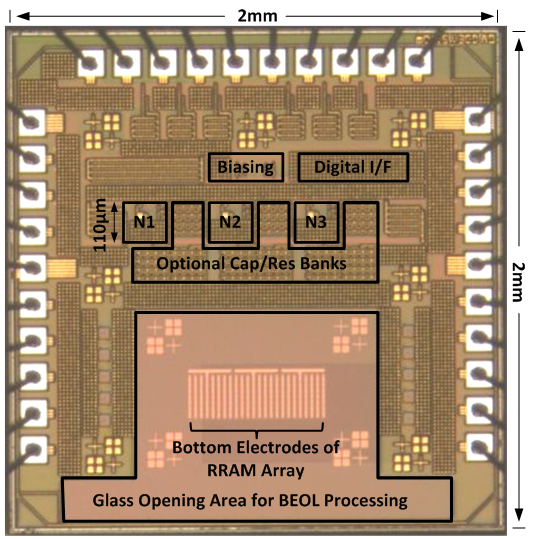
- Xinyu Wu, Vishal Saxena, Kehan Zhu, and Sakkarapani Balagopal. "A CMOS spiking neuron for brain-inspired neural networks with resistive synapses and in situ learning." IEEE Transactions on Circuits and Systems II: Express Briefs 62, no. 11 (2015): 1088-1092.
- Xinyu Wu, Vishal Saxena, and Kehan Zhu. "Homogeneous spiking neuromorphic system for real-world pattern recognition," IEEE Journal on Emerging and Selected Topics in Circuits and Systems 5.2 (2015): 254-266. (Listed in JETCAS Popular Articles, 2015).
- Xinyu Wu, Vishal Saxena, and Kehan Zhu. "A CMOS spiking neuron for dense memristor-synapse connectivity for brain-inspired computing ," IEEE International Joint Conference on Neural Networks (IJCNN), 2015.
- Xinyu Wu, Vishal Saxena, et al. "Energy-efficient STDP-based learning circuits with memristor synapses." SPIE Sensing Technology+ Applications, 2014.
Spike-based Learning Motifs using CMOS and Emerging Devices
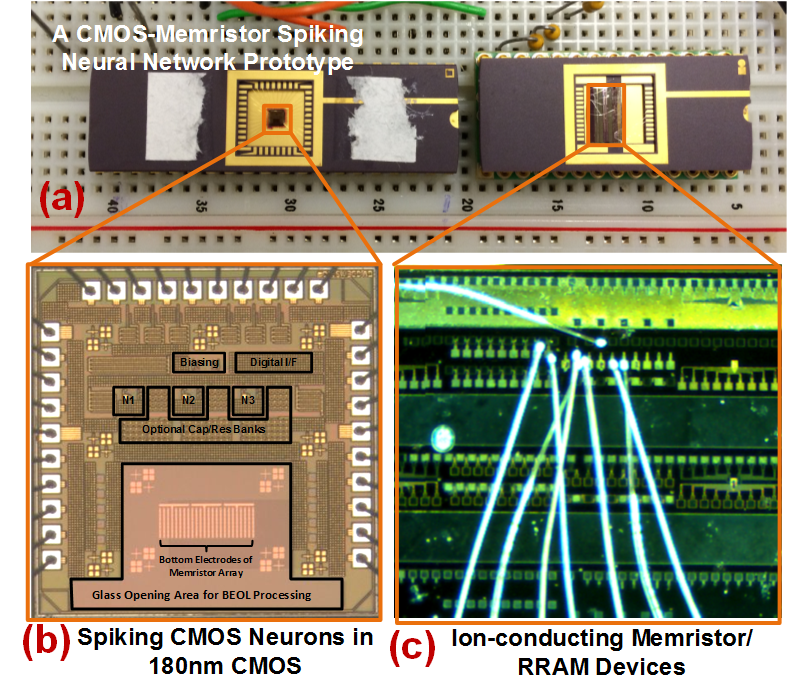 We are investigating several challenges in emergent and supervised learning of spiking neural-networks, realizing higher-level cognition and translation of emerging neural-inspired machine learning algorithms into chip scale systems with minimum circuit area and power overhead. A part of this effort was showcased in Prof. Saxena's recent talk at the Neuromorphic Computing Workshop at the Oak Ridge National Laboratory in July 2016. We are the first group to introduce bio-plausible multi-bit STDP plasticity using dendrites with bistable stochastic RRAM/memristive devices. This invention paves the path towards practical realization of spiking deep-learning architectures using realistic behavior of emerging memory/memristive devices. The image on the right shows the neuromorphic test chip with spiking neurons integrated with CBRAM synapses (courtesy Prof. Maria Mitkova of Boise State).
- Xinyu Wu and Vishal Saxena "Enabling Bio-Plausible Multi-level STDP using CMOS Neurons with Dendrites and Bistable RRAMs," arXiv:1612.01491.
- Xinyu Wu, Vishal Saxena, and Kehan Zhu, "Homogeneous spiking neuromorphic system for real-world pattern recognition," IEEE Journal on Emerging and Selected Topics in Circuits and Systems 5.2 (2015): 254-266. (Listed in JETCAS Popular Articles, 2015).
- Vishal Saxena, Xinyu Wu, and Maria Mitkova, "Addressing challenges in neuromorphic computing with memristive synapses,", Neuromorphic Computing Workshop, 2016.
Algorithm Development for Neuromorphic Hardware
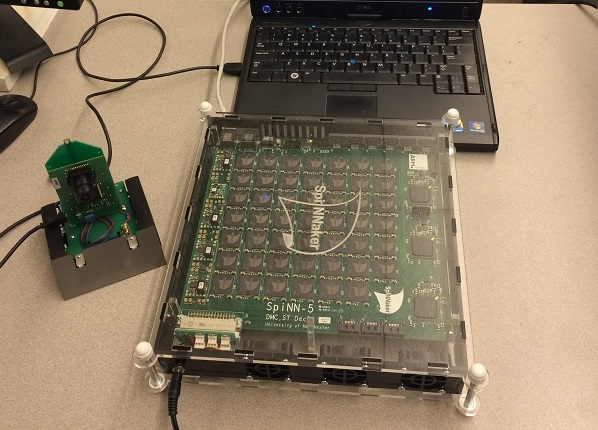 Our group collaborates with several experts in Machine Learning, Controls, Computational Neuroscience, and Signal Processing areas to develop spike-base computing algorithms using Neuromorphic platforms. These massively-parallel, spike-based computing platforms include the SpiNNaker system from the EU Brain Project, and IBM TrueNorth processor which resulted from the DARPA SYNAPSE program. The image on the right shows the SpiNNaker Neurmorphic computing platform interfaced with eDVS or silicon retina from IniLabs (courtesy Prof. John Chiasson of Boise State), which serves as one of the prototyping platform for our Neuromorphic Computing research.
Energy-efficient AER Interconnects
We are also investigating ultra low-power interconnects for event-driven (AER) communication for a large network of neuromorphic computing cores.Publications
The complete, up-to-date list of publications is on Google Scholar.
2026
- ConferenceS. Mandal, Y. Ren, and V. Saxena, “Accuracy-Efficiency Trade-offs of Temporal Enrichment in Spiking Neural Networks,” in 2026 IEEE 69th International Midwest Symposium on Circuits and Systems (MWSCAS), 2026.
- JournalA. Dorzhigulov and V. Saxena, “A CCO-based Leaky Integrate and Fire Neuron in 130nm CMOS/ReRAM Technology for SNNs,” IEEE Journal on Emerging and Selected Topics in Circuits and Systems (JETCAS), 2026.
2024
- ConferenceA. Dorzhigulov and V. Saxena, “Compact Convolutional SNN Architecture for the Neuromorphic Speech Denoising,” in 2024 IEEE 67th International Midwest Symposium on Circuits and Systems (MWSCAS), 2024.
2020
- JournalR. Vaila, J. Chiasson, and V. Saxena, “A Deep Unsupervised Feature Learning Spiking Neural Network with Binarized Classification Layers for EMNIST Classification,” IEEE Transactions on Emerging Topics in Computational Intelligence (TETCI), pp. 1–12, 2020, impact factor: 4.34 (25 Citations).
- ConferenceR. Vaila, J. Chiasson, and V. Saxena, “"continuous learning in a single-incremental-task scenario with spike features",” in ICONS 2020: International Conference on Neuromorphic Systems, 2020.
- ConferenceV. Saxena, “A Process-Variation Robust RRAM-Compatible CMOS Neuron for Neuromorphic System-on-a-Chip,” in in proc. of the IEEE International Symposium on Circuits & Systems (ISCAS), Seville, Spain, 2020.
2019
- PreprintR. Vaila, J. Chiasson, and V. Saxena, “Deep Convolutional Spiking Neural Networks for Image Classification,” arXiv:1903.12272, 2019, (29 citations).
- ConferenceR. Vaila, J. Chiasson, and V. Saxena, “Feature extraction using spiking convolutional neural networks,” in ACM Proceedings of the International Conference on Neuromorphic Systems (ICONS), 2019, p. 14.
2018
- JournalX. Wu and V. Saxena, “Dendritic Processing Enables Bio-Plausible Stochastic STDP in Compound Binary Synapse,” IEEE Transaction on Nanotechnology (TNANO), vol. 18, pp. 149–159, 2018, impact factor: 2.967 (15 Citations).
- PosterR. Vaila, J. Chiasson, and V. Saxena, “Spiking CNNs with PYNN and NEURON,” in 5th Neuro Inspired Computational Elements Workshop (NICE 2018), July 2018.
- PosterV. Saxena, “Analog Spiking Neuromorphic Circuits and Systems for Brain- and Nanotechnology-Inspired Cognitive Computing,” in 5th Neuro Inspired Computational Elements Workshop (NICE 2017), July 2018.
2017
- ConferenceX. Wu and V. Saxena, “Enabling Bio-Plausible Multi-level STDP using CMOS Neurons with Dendrites and Bistable RRAMs,” in International Joint Conference on Neural Networks (IJCNN), Anchorage, Alaska, July 2017.
- PosterV. Saxena, “Analog Spiking Neuromorphic Circuits and Systems for Brain- and Nanotechnology-Inspired Cognitive Computing,” in SRC DARPA JUMP Workshop, July 2017.
2015
- JournalX. Wu, V. Saxena, and K. Zhu, “Homogeneous Spiking Neuromorphic System for Real-World Pattern Recognition,” IEEE Journal on Emerging and Selected Topics in Circuits and Systems (JETCAS), vol. 5, no. 2, pp. 254 – 266, June 2015, impact factor: 5.01 (74 Citations).
- JournalX. Wu, V. Saxena, and K. Zhu, “A CMOS Spiking Neuron for Brain-Inspired Neural Networks with Resistive Synapses and In-Situ Learning,” IEEE Transactions on Circuits and Systems (TCAS) II: Express Briefs, vol. 62, no. 11, pp. 1088–1092, 2015, impact factor: 3.691 (143 Citations).
- ConferenceX. Wu, V. Saxena, and Zhu, “A CMOS Spiking Neuron for Dense Memristor- Synapse Connectivity for Brain-Like Computing,” in International Joint Conference on Neural Networks (IJCNN), Killarney, Ireland, July 2015.