Home / In-Memory Computing
In-Memory Computing
Mixed-signal computing with CMOS and emerging non-volatile memory.
CMOS-based Memristor and Synapses
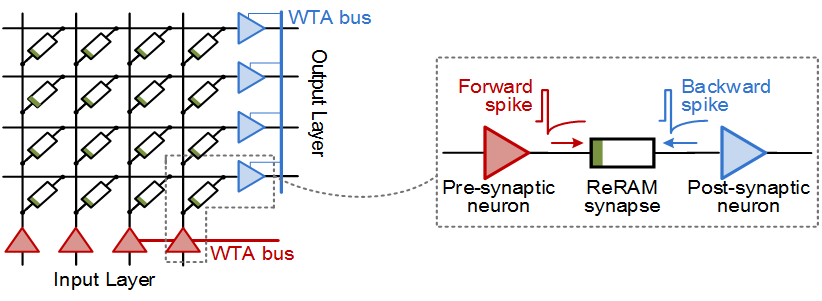
Design of transistor-based synapses with small layout footprint, biologically compatible plasticity rules and dense-integration in a nano-CMOS process with power consumption in the pJ range. We introduced the first CMOS Memristor and Memcapacitor and pioneered their use to form two-terminal Resistive/Capacitive Synapses in 2014 in our US patent disclosure. These set of inventions allow integrated circuit (IC) designers to design, fabricate, and test novel cognitive system design concepts while the 'memristor,' or resistive memory (RRAM) devices become mature and their characteristics are well understood. Further, these two-terminal CMOS synapses are a unique departure from the unidirectional conductance-based synapses in prior literature, where a MOSFET in Triode region emulates a variable conductance synapse to realize CMOS-based Dynamic synapses. These concepts thus allow designers to build CMOS neurons and synapses on the same chip, without costly process changes, and thus allow investigation of crossbar-based neuromorphic architectures.
Publications
The complete, up-to-date list of publications is on Google Scholar.
2025
- ConferenceV. Saxena and A. Moussa, “CMOS-RRAM Neuromorphic Accelerators Using Multi-bit Neurons,” in Proc. IEEE International Midwest Conference on Circuits and Systems (MWSCAS), East Lansing, MI, 2025.
2023
- JournalA. Dorzhigulov and V. Saxena, “Spiking CMOS-NVM Mixed-Signal Neuromorphic ConvNet with Circuit- and Training-optimized Temporal Subsampling,” Frontiers of Neuroscience: Neuromorphic Engineering, vol. 17, p. 1177592, 2023, impact factor: 5.512.
- Book chapterV. Saxena, "Challenges and Recent Advances in NVM-based Neuromorphic Computing ICs," Chapter in the Selected Topics in Intelligent Chips with Emerging Devices, Circuits and Systems, 1st ed., A. James and B. Choubey, Eds. River Publishers, 2023.
2022
- ConferenceA. Dorzhigulov and V. Saxena, “Hybrid CMOS-RRAM Spiking CNNs with Time-Domain Max-Pooling and Integrator Re-Use,” in in proc. of the IEEE International Symposium on Circuits & Systems (ISCAS), Austin, TX, May 2022.
2021
- JournalV. Saxena, “Mixed-Signal Neuromorphic Computing Circuits using Hybrid CMOS-RRAM Integration,” IEEE Transactions on Circuits and Systems II: Express Briefs, vol. 68, no. 2, pp. 581–586, 2021, impact factor: 3.691 (10 Citations).
- ConferenceV. Saxena, “A Mixed-Signal Convolutional Neural Network Using Hybrid CMOS-RRAM Integration,” in in proc. of the IEEE International Symposium on Circuits & Systems (ISCAS), Daegu, South Korea, 2021.
2019
- ConferenceV. Saxena, “High LRS-Resistance CMOS Memristive Synapses for Energy-Efficient Edge-AI and Neuromorphic System-on-a-Chip,” in (invited) IEEE Int. Midwest Symposium on Circuits and Systems (MWSCAS), 2019.
- PosterV. Saxena, “Monolithically Integrated CMOS-NVM Neuromorphic System on a Chip for Real-Time Cognition,” in SRC DARPA JUMP2.0 Workshop, 2019.
2018
- ConferenceV. Saxena, X. Wu, and K. Zhu, “Energy-Efficient CMOS Memristive Synapses for Mixed-Signal Neuromorphic System-on-a-Chip,” in IEEE International Symposium on Circuits & Systems (ISCAS), 2018.
2016
- Conference
(non-refereed)V. Saxena, X. Wu, and M. Mitkova, “Addressing Challenges in Neuromorphic Computing with Memristive Synapses,” in U.S. DoE Neuromorphic Computing Workshop, Oak Ridge National Laboratory, July 2016.
2014
- ConferenceW. Xinyu, V. Saxena, and K. A. Campbell, “Energy-efficient STDP-based learning circuits with memristor synapses,” in proc. SPIE Machine Intelligence and Bio-inspired Computation, Baltimore, 2014.
2013
- JournalT. Tran, A. Rothenbuhler, E. H. Barney Smith, V. Saxena, and K. A. Campbell, “Reconfigurable Threshold Logic Gates using Memristive Devices,” Journal of Low Power Electronics and Applications, vol. 3, no. 2, pp. 174–193, 2013, impact factor: 2.1 (46 Citations).
2012
- ConferenceT. Tran, A. Rothenbuhler, E. Barney Smith, V. Saxena, and K. Campbell, “Reconfigurable Threshold Logic gates using Memristive Devices,” in IEEE Subthreshold Microelectronics Conference, Waltham, MA, 2012.