Catalyzing Delware High School Students in the Presidential AI Challenge Participations
Supported by the National Science Foundation, the University of Delaware’s Department of Electrical and Computer Engineering offered expert mentorship and stipends to local high school students to compete in the national Presidential AI Challenge. We are proud of the outstanding participation of the three Delaware high school teams that we mentored and competeed in the Presidential AI Challenge:
Teams:
STUDY BUDDY - THE RESPONSIBLE AI TUTOR was developed by Alvin Abbey of Odyssey Charter School, who was supervised by Theresa Emmett, the director of Four Youth, a non-profit organization headquartered in Wilmington, Delaware. This project details a distinct responsible AI tutoring solution aimed at assisting students with personalized, ethically sound academic support throughout their schooling. It was thoughtfully designed to encourage homework engagement.
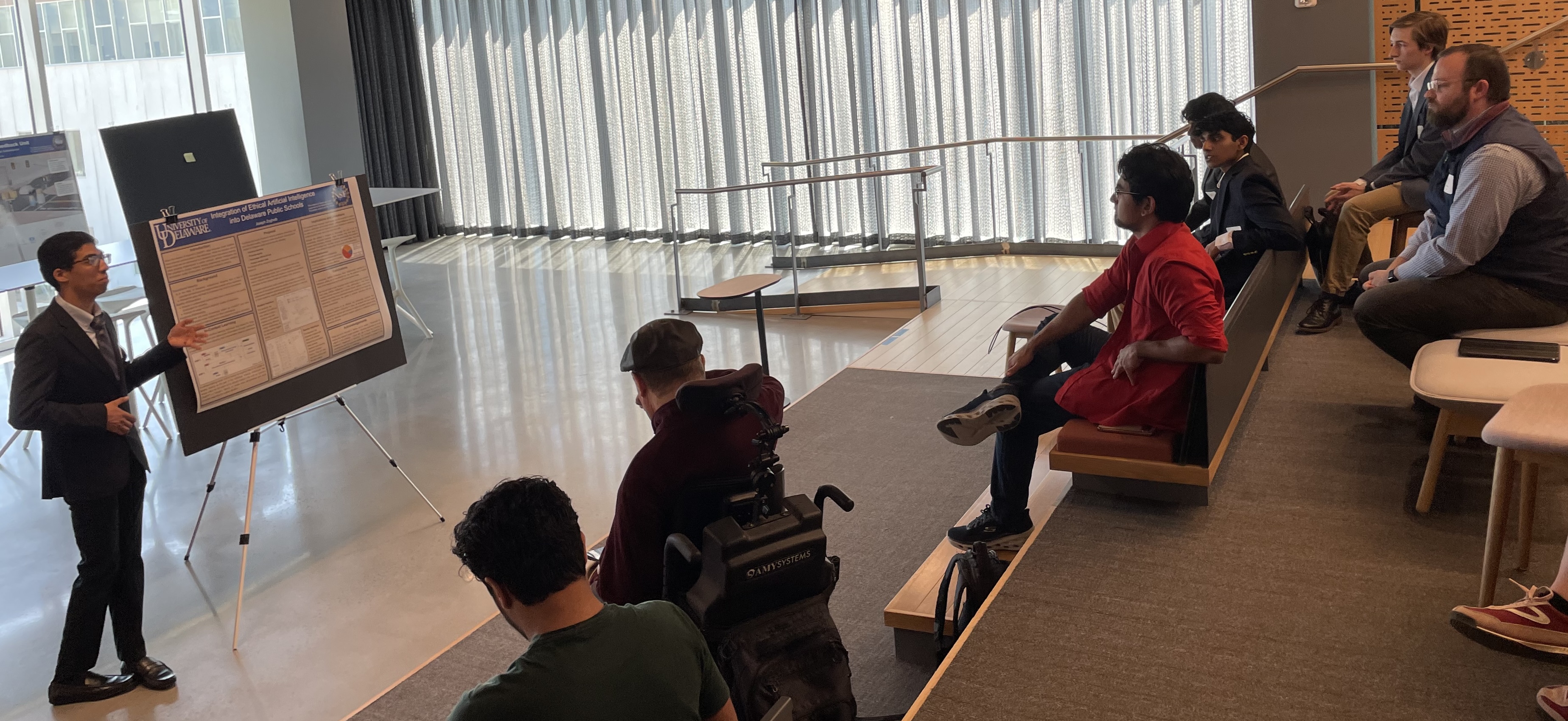
INTEGRATION OF ETHICAL ARTIFICIAL INTELLIGENCE INTO DELAWARE PUBLIC SCHOOLS was submitted by Joseph Zogheib from Concord High School, supervised by his parent, Karen Zogheib. This project directly addresses the growing challenge of AI misuse in education. The project’s core issue is the increasing use of general-purpose chatbots (like ChatGPT) by students, which the proposal argues stunts learning and exacerbates existing educational disparities.
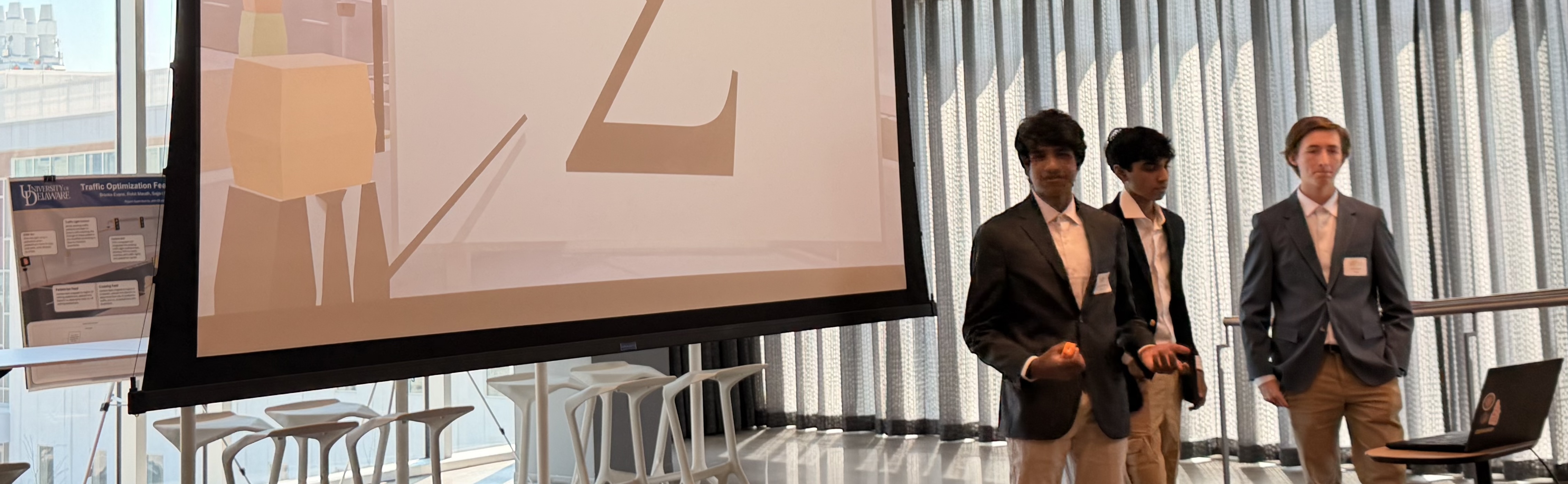
TOFU - TRAFFIC OPTIMIZATION FEEDBACK UNIT Artificial Intelligence and Machine Learning to Improve Traffic and Pedestrian Flow at Busy Intersections includes members Robert Evans, Rohit Marath, and Sajjan Subramanian. They developed an innovative proposal that applies artificial intelligence and machine learning to improve traffic and pedestrian flow at busy intersections, such as those in Newark, Delaware. The students from Caravel Academy were supervised by John Olinda.
Their proposed system integrates computer vision and reinforcement learning to dynamically adjust pedestrian and vehicle signal timing. Cameras mounted on traffic signals would detect and track vehicles and pedestrians using modern object-detection models, while a reinforcement-learning system would analyze traffic patterns to optimize crossing times and minimize unnecessary delays.
The design uses real-time vehicle and pedestrian detection and tracking to estimate traffic flow, enabling the system to dynamically adjust signal timing rather than relying on fixed intervals. This approach could reduce congestion, decrease pedestrian wait times, and improve safety by discouraging risky crossings and adapting to conditions such as crowded events or the presence of pedestrians with disabilities.
All three projects reflect both technical sophistication and thoughtful consideration of the ethical and societal implications of AI.
Team TOFO has been selected as a State Champion in the Delaware Competition and competed in the Northeast Regional Competition. Congratulations to Robert, Rohit, and Sajjan for their impressive work and creativity! Out of more than 2,500 submissions nationwide, only 328 teams were selected as state-level winners, making this a significant accomplishment for these students and their school.
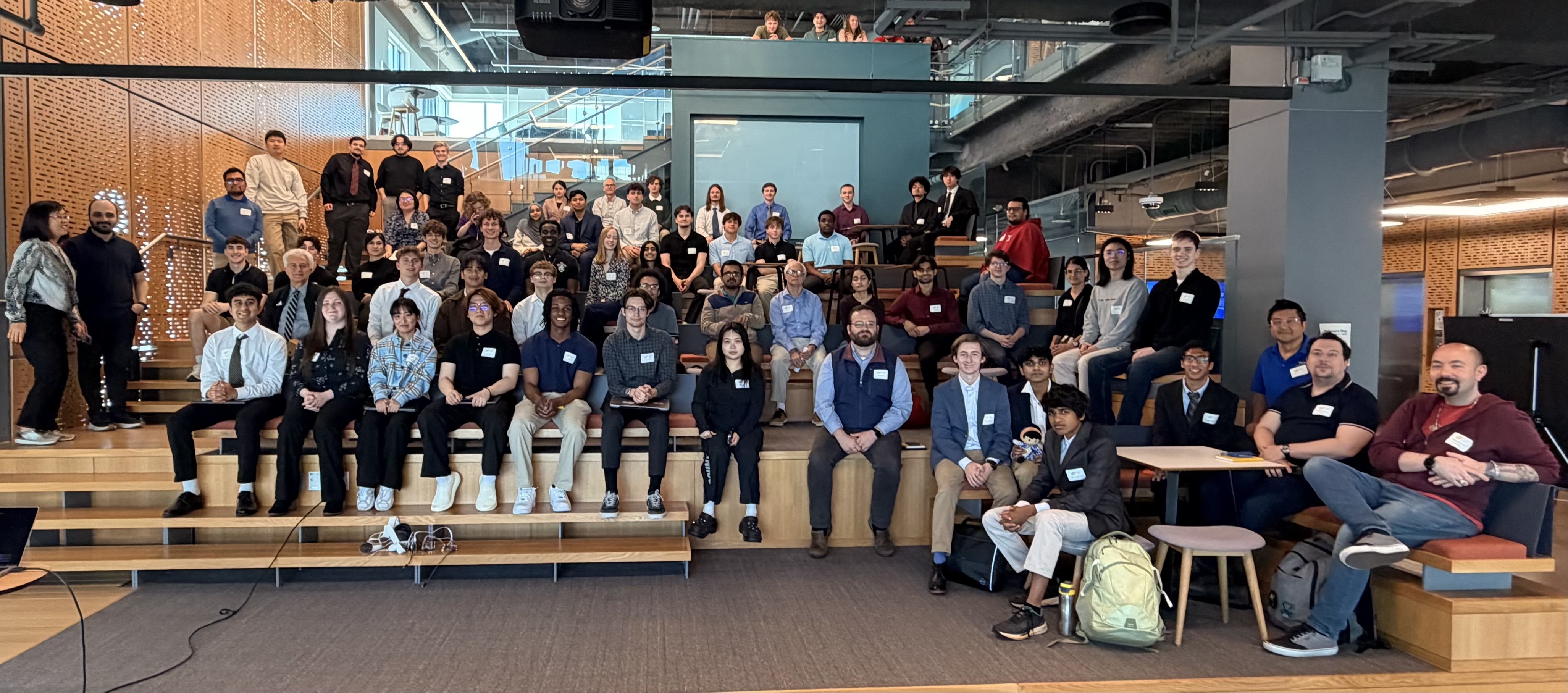
The three Presidential AI Challenge teams also presented their work at the Delaware AI Showcase at UD held on Friday, April 10, at the FinTech Innovation Hub (STAR Campus). Students were invited to stay and share their projects with undergraduate students and faculty involved in the first annual Vertically Integrated Project (VIP) Course Showcase, which celebrated innovation and entrepreneurship by showcasing student projects from several VIP teams. The event featured high-energy Lightning Talks (3-minute pitches), an Interactive Poster Mixer where attendees voted for the best projects, and concluded with a Reception & Awards ceremony that included networking.
These activities were supported by a National Science Foundation (NSF) grant awarded to the Center for Cybersecurity, Assurance, and Privacy at the University of Delaware and the Electrical and Computer Engineering Department at the University of Delaware. This initiative expands opportunities for high school students across the state to engage in AI, data science, and advanced computing research.
This material is based upon work supported by the National Science Foundation under Grant No. 2336586 through supplemental funding for the Presidential AI-Youth Challenge Competition. Any opinions, findings, and conclusions or recommendations expressed in this material are those of the author(s) and do not necessarily reflect the views of the National Science Foundation.
Original Information for Participants Below:
What ideas do you have to identify community-based problems where AI can be part of the solution?
Supported by the National Science Foundation, the University of Delaware’s Department of Electrical and Computer Engineering is offering expert mentorship and $120 stipends to local high school students to compete in the national Presidential AI Challenge, which ends Jan. 20th.
High school student teams will work on projects that propose or implement how AI can be used to solve community problems, vying for prizes that include an all-expenses-paid trip to D.C. and a $10,000 national championship award. Each team will consist of 1–4 students in grades 9–12 and need a supervising adult (educator, community organizer, or parent) to attend sessions, register the team and submit the project. For those interested, UD will work with the teams and can provide feedback and resources to develop the proposals or AI solutions for community issues.
The grant money will offer participant support ($120 per student or adult) for a select number of students (16 or more) and supervising adults who register and successfully submit materials and continue to participate with AI-related sessions leading to the Delaware AI Showcase in April 2026. Teams will have the opportunity to receive gift cards to cover AI-related electronics kits and receive further mentoring.
Basic information
-
Presidential AI Challenge launched in fall 2025. Project submission deadline of January 20, 2026. The challenge deadline is less than 3 weeks away!
-
University of Delaware faculty and staff will provide mentoring and guidance based on NSF support to the University of Delaware’s Electrical and Computer Engineering Department through UD’s Center for Cybersecurity, Assurance and Privacy.
-
Ultimately, the AI Challenge is really up to the students to explore how they can make an impact in their community using AI.
-
Step 1 is to form 1–4 youth teams (need supervising adult 18+ years of age).
-
Step 2 is to brainstorm, learn more, get help, and complete submission by the 20th.
-
Two tracks (given limited time, we suggest considering Track I (Proposal) compared to Track II (Technical Implementation).):
-
Project Track 1 (Proposal; Poster) Propose how AI technologies could address a community challenge with detailed analysis and justification. Teams create an in-depth proposal for how AI technologies could be applied to address a community problem or challenge. This proposal must address an observed challenge in the student’s community, detail the mechanisms for applying AI technologies, and elaborate on how AI technologies could help address that challenge.
-
Project Track II (Technical/implementation; Video (demo or walkthrough) or Poster): Build a functional AI-based solution for a real community problem and demonstrate its application. Solutions could take many forms, such as phone apps, websites, or processes, with supporting materials showing how people would leverage the technologies and how AI technologies are helpful in addressing that challenge.
-
-
Project submission: All teams will submit a written project summary that reflects on learning achievements, detailing research and lessons learned.
-
Why? All compliant submissions get Presidential Certificate of Participation, chance to win State Championship, Cloud Credits and Invitation to 3-day, in-person event in DC for Regional Champions, and Chance to win $10,000 per team member for National Champions. Up to 16 participants (and supervising adults) will receive $120 stipends (money to cover time). Additionally, participants registered with UD have the chance to receive free electronic kits (to create real-world AI-enabled solutions), join additional AI tutorial sessions, and be invited to the Delaware AI Showcase in April 2026 to be held at UD.
Schedule
-
January 8th (4pm or 8:15 pm) UD office hours. Email ajbrock@udel.edu for invite.
-
January 9–13th, team formation! Register by the 13th. Student registration form Supervising adult registration form
-
January 12th (7pm) Presidential AI Challenge Office Hours link Only students part of registered team and accompanied by supervising adult should attend.
-
January 13th. Deadline for students to register as participants with the UD (and possibly get $120 stipend). Student registration link
-
January 14th (8:15 pm). Short overview of AI Challenge and office hours for finalizing teams.
-
January 15th. Office hour (8:15 pm). Join and discuss ideas with Profs. Barner and Brockmeier. Goal is to review ideas, offer feedback, and provide assistance in any form.
-
January 16th. Draft of project materials and begin to prepare for submission.
-
January 17th (Saturday, 10am – noon). Dr. Brockmeier and graduate student mentor will host Zoom check-ins to review project materials and prepare for the submission to the Presidential AI Challenge.
-
January 19th (7pm) Presidential AI Challenge Office Hours link Only students part of registered team and accompanied by supervising adult should attend.
-
January 20th, 2026 (Tuesday): Project Submission due at 11:59pm
-
February–March 2026: Continued Mentorship for Showcase Preparation—Teams continue to prepare for the Delaware AI Showcase. With biweekly virtual check-ins.
-
April 2026: Delaware AI Showcase (Date and time to TBD), Evans Hall, The Green, Newark, Delaware.
Information for Zoom Session with Adults
- Step 1. Team Formation
Teams consist of 1-4 youth and one Supervising Adult (18+ years of age) who will submit the Challenge project
-
UD’s supervising adult registration form
- Note #1: No one under 18 years old may attend ANY session without the team’s Supervising Adult.
-
Step 2. Collect Consent Forms Supervising Adult will Obtain Parental Consent Forms for all youth before the team can begin participating in any mentorship or training activities sponsored by the Challenge, and complete the Supervising Adult’s Consent and Media Release Form
-
Note #2: All attendees must be fully registered with submitted consent forms.
-
Note #3: For the Parent or Legal Guardian signature: Print the form, sign in ink, take a photo with a phone, and email to the Supervising Adult. Adobe esign is also acceptable, as well as uploading and inserting a copy of the parent or legal guardian’s signature. All electronic signatures must represent the parent or legal guardian’s actual signature.
-
-
Step 3. Send consent forms When ready to register, send an email to AI.Challenge@science.doe.gov with consent forms (Parental Consent Forms, Media Release Forms) and include the name of the supervising adult in the text of the email
-
Step 4. Register Done by supervising adult. Overview below Link
-
Registration Form Step 1. Agree to privacy agreement for the competition.
-
Registration Form Step 2. Select level. ( High School)
-
Registration Form Steps 3–5. Name and email of Supervising Adult.
-
Registration Form Step 6. Relationship of Supervising Adult to Team.
-
Registration Form Step 7–9. City, State, and Zip of team.
-
Registration Form Step 10. Confirmation that Supervising Adult is 18 years of age.
-
Registration Form Step 11. Confirmation that Supervising Adult will collect and email Parental Release Forms. (Supervising Adult’s name should be in the text of the email.)
-
Registration Form Step 12. Release form for Supervising Adult.
-
Registration Form Step 13–18. Add information on the first student.
-
Registration Form Steps 19– Add information on second student, third student, and so on.
-
Submission guidelines Scoring Guides
-
Each submission must include a 500-word minimum, team-authored narrative that clearly explains the team’s project and cites any tools and primary sources used for both the project and the preparation of the narrative. Some considerations to keep in mind when preparing the narrative include:
-
Track I:
-
What specific community problem are you addressing, and why does it matter?
-
Who is affected by this problem, and how?
-
What kind of AI technologies or methods are you proposing?
-
How will AI tools or methods help solve or address the problem?
-
What research did you conduct to support your ideas?
-
Did you explain any difficulties or obstacles you encountered in developing your proposal?
-
What makes your approach or solution unique?
-
Did you clearly explain how AI tools or methods are used and ensure that your proposal is realistic, effective, and responsible?
-
What did you learn from working on this project?
-
Is there anything else you would like to share about your project?
-
Is your narrative reflective, organized, and at least 500 words?
-
-
Track II:
-
What community problem are you solving, and who benefits?
-
What AI methods, tools, or platforms did you use?
-
How does the AI component work in your solution?
-
What challenges did you face during development, and how did you address them?
-
In what way is your solution creative or innovative in how it applies AI technologies?
-
How did you test or verify the accuracy of any AI-generated content, outputs, or predictions (if applicable)? How accurate did you find the outputs to be?
-
How did working on this project deepen the team’s understanding of AI technologies and their appropriate and responsible use?
-
What did you learn from working on this project?
-
Is there anything else you would like to share about your project?
-
Is your written explanation clear, at least 500 words, and reflective of your journey?
-
Does your media (e.g., video, slides, app walkthrough) explain the project well and engage the viewer? The team’s PDF submission must include links to videos (no longer than 4 minutes), digital posters, or websites to be viewed by the judges.
-
-
Each submission must include a Certification of Originality, stating the following:
The project submission is original content created specifically for the Challenge. All AI tools or technologies used are identified and credited. All research and artifacts (e.g., maps, photos, etc.) are identified and credited.
-
All deliverables (project narrative and supplemental media) must be included or linked to in a single PDF document that: Is no larger than 50 MB; Is no longer than 10 pages in length; and Uses 12-point (or larger) font size.
-
The PDF document must also include:
-
Track I: A link (accessible with no password) to the presentation poster, either digital or a photo of a physical poster.
-
Track II: A link to a poster or video or demonstration of the technology solution. The video entry should consist of a single, 4-minute maximum video. When creating the video, a good best practice is to talk as if you are reiterating the question in your response. (Ex: “Our proposed solution to the problem is…” or “Our team’s solution is innovative and different because….”). Please try to maintain a maximum file size of 300 MB. Recording a team Zoom call for the 4-minute video is an option for the video. Videos do not have to include credits, but if they do, these must be included in the 4-minute time limit. Videos can be shot and edited by someone not on the team; however, the subject(s) of the video and its content must be created by team members. Your video will need to be successfully uploaded to your platform before you can complete your submission. Please allow enough time prior to the submission deadline to upload your video.
-
-
To receive the team’s Presidential Certificates of Participation, go to the Challenge website, AI.gov, to submit and upload your PDF with project narrative and links to additional media no later than January 20, 2026, at 11:59pm local time.
Other Resources
For more information, please see the Presidential AI Challenge Guidebook.
A recording of podcast with Dr. Austin Brockmeier for 1st year engineers at UD link
Recordings from many webinars in the fall. link
A paper on the modern potential and future impact of AI by computer science researchers link.
Check out the Artificial Intelligence section (5 min. read).