2026
Diffusion-Based Joint Recovery, Denoising, and Super-Resolution of Compressed-Sensing Satellite LiDAR Data
IEEE Transactions on Computational Imaging
Diffusion models, GANs, and uncertainty-aware inference for accelerated, high-fidelity reconstruction in scientific imaging.
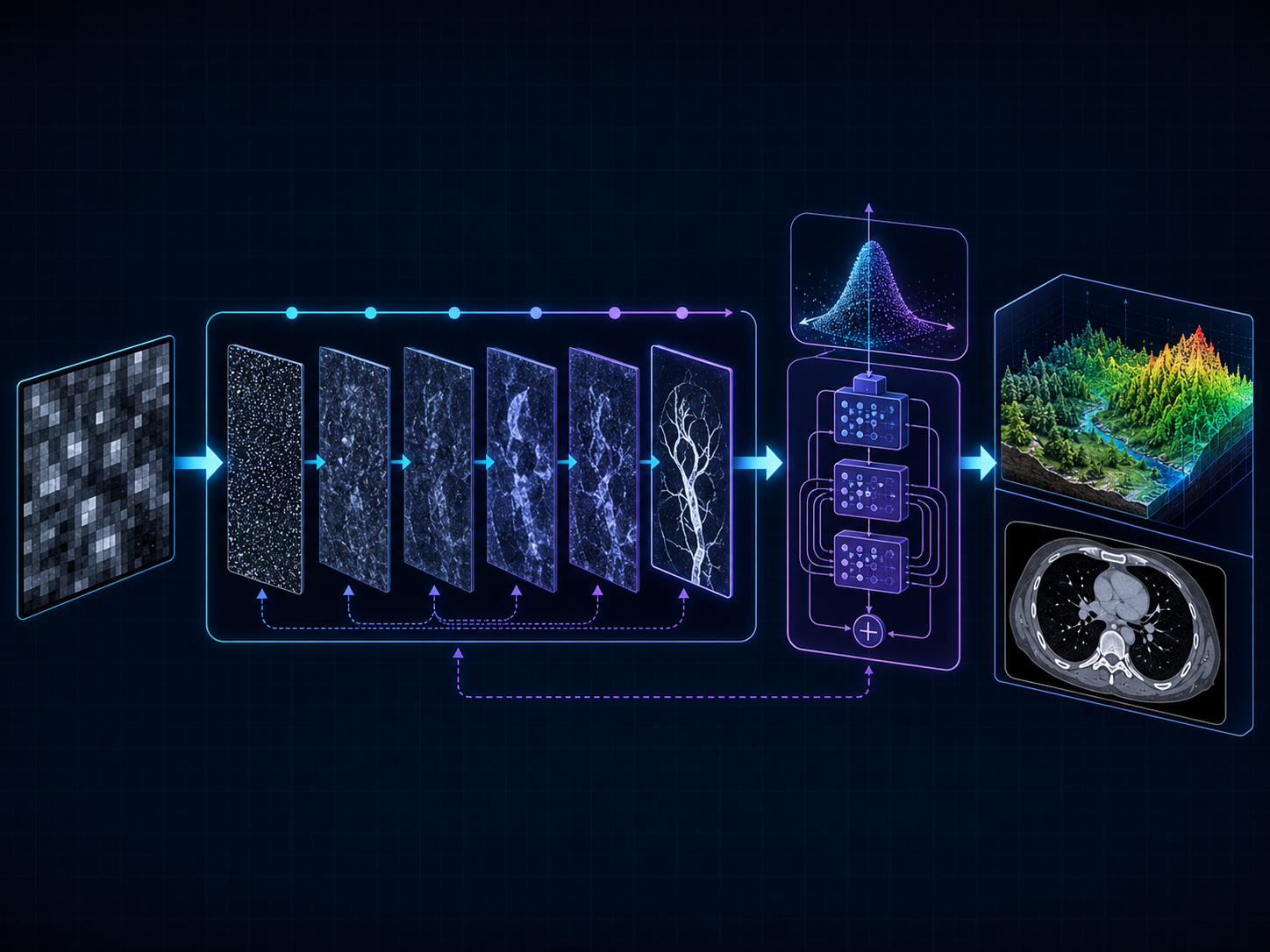
The group brings modern generative models to scientific inverse problems, using diffusion, adversarial, and autoregressive priors to recover, denoise, and super-resolve severely undersampled data. Learned priors capture the structure of natural scenes and physical signals, filling in detail that classical regularizers cannot.
We design and implement new generative methods built on Visual Autoregressive (VAR) modeling, which generates images by next-scale prediction rather than pixel-by-pixel. We combine it with wavelet decomposition, so the model predicts coarse-to-fine wavelet subbands and recovers fine detail at far lower cost than iterative diffusion sampling.
Applications include super-resolved 3-D satellite LiDAR, submeter topography and vegetation mapping, and low-dose X-ray CT, together with objective and subjective quality assessment of the generated reconstructions.