 colors.
{
A coloring of the vertices of an undirected graph means that
colors are assigned to the vertices such that adjacent vertices have
different colors. Prove that if a graph has e edges, then that graph
may be colored using at most colors.
We will present an algorithm which, given a graph with e edges,
produces a coloring of the graph using  colors.
Order the vertices of the graph in a list  by decreasing
degree (highest degree first).
by decreasing
degree (highest degree first).
 is a set of
  colors.
 is the vertex
currently being examined.
is the vertex
currently being examined.
 contains
colors of previously colored vertices adjacent to
contains
colors of previously colored vertices adjacent to  .
.
FOR i=1 TO n DO
BEGIN
Examine vertices adjacent to vertice  , and collect
their colors
, and collect
their colors
into  .
.
Choose a color from  for
for  that is not in
 .
.
END
We will show that the above algorithm produces a valid coloring of any graph G.
For any graph G, the total degree of all nodes is 2e. Intuitively,
the nodes that are going to cause us to use too many colors (if any)
are the nodes of highest degree. Let us separate the vertices into
two categories: those with degree  and those with
degree
and those with
degree  .
.
Consider vertices with degree  . The sum of the degrees of all
vertices in a graph is 2e (because each edge is counted by vertices
at both ends). How many vertices with degree
. The sum of the degrees of all
vertices in a graph is 2e (because each edge is counted by vertices
at both ends). How many vertices with degree  can there be?
Divide the total degrees, 2e, by
can there be?
Divide the total degrees, 2e, by  , to obtain
  vertices.
Using  colors, give each vertice with degree
  a
different color. Now all that is left to color are vertices with
degree
a
different color. Now all that is left to color are vertices with
degree  .
.
A vertex v with degree  has fewer than
  edges
incident upon it, and so fewer than
edges
incident upon it, and so fewer than  vertices can be
adjacent to v. Thus the adjacent vertices of v can have used at
most
vertices can be
adjacent to v. Thus the adjacent vertices of v can have used at
most  colors from
  ; but
; but  , meaning there is an available color
from
, meaning there is an available color
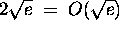
from  to color v. Finally,
  .
.
Points
0 - 5 workable algorithm
0 - 5 proof
This document was generated using the LaTeX2HTML translator Version 95.1 (Fri Jan 20 1995) Copyright © 1993, 1994, Nikos Drakos, Computer Based Learning Unit, University of Leeds.
The command line arguments were:
latex2html -split 0 p0.tex.
The translation was initiated by Errol Lloyd on Fri Aug 29 16:20:41 EDT 1997