|
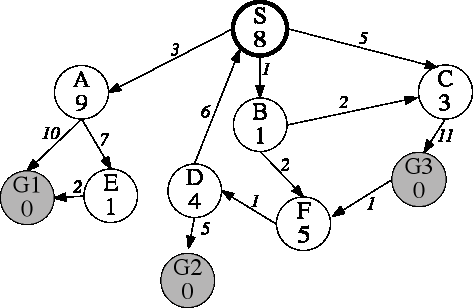
Written Homework #2 Due March 9 1. [35] Consider the following state-space graph with Start State S and Goal states G1, G2, and G3, heuristic function values and path costs noted:
Assuming that successor states are generated in alphabetical order (in stack-based algorithms, placed on the Open List in alpha order either at the start or at the end), and ties (for priority-queue based algorithms) broken in alphabetical order, in what order are the nodes in this graph expanded by each of the following search algorithms? Also for each, what is the cost of the path found? If the path found is not optimal, briefly explain why the algorithm didn't find the optimal path. Do not remove repeated states (i.e. state A).
2. [15] Problem 3.17 from the book. (five parts) 3. [8] Problem 4.2 (four parts) 4. [8] Problem 5.4 (two parts) 5. [9] Prove that if a heuristic function
h is monotonic (consistent), then it is admissible. Recall that “h
is consistent” means where n' is a direct successor of n via action a. UNDERGRADS (481): Only those taking 481 need to do problems 6 and 7. 6. [15] Problem 4.9 (there are three parts) 7. [10] In the "Four-Queens puzzle", we try to place 4 queens on a 4x4 chess board so that none can capture any other (that is, only one queen can be on any row, column, and diagonal of the array). Suppose we try to solve this problem with the following problem space: The start node is labeled by an empty 4x4 array; the successor function creates new 4x4 arrays containing one additional legal placement of a queen anywhere in the array; the goal predicate is satisfied iff there are four queens in the array (legally positioned).
GRADUATES (681): Only those taking 681 need to do problems 8 and 9. Graduate students taking the prelims are also responsible for the material in Chapter 6 of Russel and Norvig on Game Tree searching. In particular, you'll want to understand minimax and alpha-beta pruning. 8. [16] Problem 6.1 in the book; parts b, c, d, and e. 9. [5] 6.12, part a. 10. [4] The minimax algorithm returns the best move for MAX under the assumption that MIN plays optimally. What happens when MIN plays suboptimally? |
|
 |
|